Showing posts with label mobility. Show all posts

Tuesday, September 09, 2008

Baby Feet

Baby feet. When you think of them, you think of something beautiful and amazing—tiny yet somehow strong, envisioning all the places that newborn baby might walk and all the things he might do in his life. A new beginning with new, soft, beautiful, adorable feet to use on the journey. You just want to kiss those cute wittle toes.

It all starts with the baby shower. The gift tags, gift bags, greeting cards—so many of them have pictures of tiny baby footprints on them. The mother-to-be might get a kit to press the baby’s feet into clay to make a keepsake of the footprints. Special frames are used in anticipation of the big event—the baby’s birth and the footprints, which can be framed for posterity or put into an album. 10 perfect fingers and 10 perfect toes. These frames often come with little poems:

Two little feet, ten little toes,
Leave their impressions today.
Soon they will wear two little shoes,
And be running
and jumping at play.
Two little feet, too little time,

Before they are walking to school,
Kicking a rock, or skipping a rope,
Wading a
puddle or jumping a pool.
Two little feet, one little child,
Will soon go the
ir own way,
But footprints in my mind recall,
They stood here yesterday


Or short and simple:

Little hands, little feet
Pure and precious, and Oh So Sweet!


A baby makes footprints in our hearts
that never
dim or fade.

Where ere a baby's little footprints are found,
There is precious and hallowed ground.


The pitter patter of little baby feet
is music to the ears and ever so sweet!


In parenting magazines, it seems that every single baby and toddler is shoeless and sockless. I did a little study of it recently, and it’s hard to turn 5 pages without seeing some baby feet! No one wants to cover up those precious little toes!

It was into this world that my son, Jordan, was born, a baby with clubfeet along with a dislocated knee and dislocated hips. It was hard to look at his little footprints on the piece of paper. The doctors immediately started saying how he “wouldn’t be much of a walker,” and they began casting his feet when he was 9 days old. He had two surgeries on each foot and one on his knee, all in the first 15 months of his life. Plus, physical therapy, braces, walkers, crutches. Instead of cute little socks or letting him go barefoot, my baby was in casts for almost the first year of his life, and after that, braces almost 24 hours a day, including the brace with a metal bar between the feet. When he was around 4, he had more casting done to align his feet again--with his condition, his feet keep trying to go back to how they were when he was born. They keep trying to adjust his feet until he stops growing, and then they will stay where they are when he's an adult.

When he was about 2 months old and all of this was so new to me, with so many doctors appointments and so many dire prognoses, one day we took a break and went to Babies R Us. We went into the nursing/changing room in the back. I loved that they had this little room set up for us. It was so comfortable, with sofas, a changing table, room to just sit back and relax. Feeling relaxed for the first time in a while, I looked up from feeding him for a minute, and right in front of us on the wall was a huge probably 5 foot by 8 foot poster, a close-up of baby feet! I couldn’t escape!

Many times seeing those photos of the cute baby feet--and even the feet of my friends' and relatives' kids, who always seem to go around barefoot--tore at my heart. Why was it so easy for everyone else? Why were these babies crawling and then walking, not using any devices, not using any braces, when they were still SUCH BABIES, while my son talked like a professor so early, gave us “lectures,” as he called them, at age 1½, knew all the words to book upon book of nursery rhymes before he was 2, started sounding out words at age 3?

Someday I'll jump through puddles,
Take a stroll or run a race.
Someday I'll walk across the street,
Or maybe walk in space,
Someday I'll scale a mountain,
Or I'll join a ballet corps.
Someday I'll walk a tightrope,
Or explore the ocean floor.
Someday these feet will do some things,
That only heaven knows,
But for today they're happy
Just to wiggle all their toes.


Some babies can’t wiggle their toes and will grow up never wiggling them. The only toe Jordan can move is his big toe on his left foot. He has no movement at all in his right foot. But he does jump through puddles—using a walker and braces. He does whatever he wants. He doesn’t know about the stress this has caused me, having him not fit into the “mold” of the “perfect baby” that is drummed into our heads. He is just himself—rough, tough, sensitive yet strong, hilarious, and “all boy.” I now look back at his baby footprints and see something different—the feet were so tiny and were not aligned perfectly, but they are the feet of MY little boy.

Just 2 weeks ago, he took his first steps without his walker or crutches. I was happy about it, but suddenly I realized that it didn’t mean as much to me as it once would have. I know now that the important thing is that he can get around independently, and whatever device he has to use to do that best is okay with me. The doctor is now talking about another surgery for Jordan's feet and knees. I am looking into nonsurgical options because I now wonder if all of this has been too much, trying to align things to make them LOOK good. But if they're working for him... It's a hard balance. I don't want there to be any damage to his knees or feet from walking the "wrong way," yet I don't want him to go through anymore surgeries if they're not totally necessary.

In the meantime, the doctor said that the braces with the bar between them really aren’t doing any good for him anymore. So for the first time in his life, he does not have something on his feet while he sleeps. I lie there next to him in bed and make sure his bare toes are touching my leg. They feel so cozy and soft, like they belong there. The beautiful, perfect toes of my little boy.

Monday, December 10, 2007

“Handicapped”

When my son was born with a dislocated knee, dislocated hips, clubfeet, and missing the lower part of his spine, and they said he might never walk (might not even LIVE), I thought I knew what it meant. I had just spent the last 5 weeks of my pregnancy in a cast from my toes to my knee, after breaking my ankle when I was 8 months pregnant.

Anyone who has been 8 and 9 months pregnant knows how often you have to go to the bathroom. The first night, I had to sleep on the sofa downstairs, and with no access to a bathroom on the same floor, my dad brought over his portable toilet they use while camping. It was a Sunday night, so I had to wait until the next afternoon to get my leg casted. I couldn’t take any pain medications because I was pregnant, so I spent the night in agony on that sofa, getting up several times to use the portable toilet, which was sitting on one of our living room chairs.

After getting my cast on, I managed to crawl up the steps to our house backwards, but then I had to haul myself up into a desk chair with wheels on it. We called it the FDR’s wheelchair because of how old and rickety it looked. But other chairs were too high for me to hoist myself up into. So I had to use my arms and the non-broken leg—I couldn’t put any weight whatsoever on the broken ankle—to lift up this heavy body I wasn’t used to. My family wasn’t giving me any help, really. They wanted me to “keep active.” All I thought about was keeping the baby safe.

I had to convince them to let me have a wheelchair; they thought I should walk on crutches so I’d be more active. But after falling down stairs and breaking my ankle, I wasn’t very confident about using crutches. I had never used them before, and I thought being 8 months pregnant, after already falling once, it was not the time to learn.

This late in pregnancy, it’s hard to sleep anyway, and now they say you shouldn’t sleep on your back when you’re pregnant. So, I had to sit up in bed with my leg elevated. It was hard to sleep, too, with the number of bathroom trips I had to make. The first week, before I had my wheelchair, I had to walk down the hall in the middle of the night, about once an hour, on crutches, scared I was going to fall again. Then when I did have the wheelchair, it was hard to move myself from the bed into the chair because there wasn’t much room for it next to the bed. When I was in the chair, I would wheel down the hallway, and then because the wheelchair couldn’t fit in through the bathroom door, I had to stand up at the door on one leg, grab my crutches, and take a few uncertain steps on them before plopping down as gently as I could on the toilet (ie, not gently at all), worried with every movement that I’d do something to hurt the baby.

To get into the shower, I’d have to step over the edge of the tub and then shower on one leg, and I wasn’t comfortable doing that. Also, we never realized we could put a plastic bag over my cast. So, I took sponge baths. I sat on the toilet, put a few towels over my cast, and then bathed from the water in the yellow bucket that I’d gotten as a baby shower gift. (The bucket had been the “gift basket,” and inside were all kinds of cute baby bath things such as washcloths, baby lotions, and baby shampoos.) I’d wash my hair and then rinse it by leaning over the tub and pouring a pitcher of water over my head. I took my time with these sponge baths; it was one of the only times of day when I felt fresh, clean, and comfortable—and not afraid that I wasn’t going to fall down (mainly because I was already sitting down)!

During those 5 weeks, I rarely went out, mostly to doctor’s appointments. The first time my ob/gyn saw me with the cast, hobbling out of the bathroom on crutches, she looked shocked and shouted, “You can’t deliver a baby LIKE THAT, with THAT on your leg!!!”

The day I got the wheelchair, my dad insisted on taking me out to the movies. I really didn’t want to go, but he thought I needed to get out. What I remember most about it was hard it was to use the bathroom. It was hard to open the doors to get into the bathroom, and then when inside the stall, the handrails on the walls were very wobbly, and some were coming off the walls. And the floor was slippery when I tried to haul myself from the wheelchair onto the toilet, and of course I was terrified as usual that I would fall and hurt the baby.

Also, he dropped me off at the door to park the car, and when I went to the ticket booth to buy our tickets, the man working there took a while to notice I was there because I was so low down in the wheelchair. Then he barely looked at me. It might not have been me, but that was how I perceived it, that he was “looking down on me” because I was in a wheelchair. And doors were slammed in my face whenever we went to the movies. No one would stand there and hold a door for me.

I was due to get the cast off 1 week before having the baby. Of course, he came a little early, and I still had the cast on when he was born. He was turned the wrong way, so I had to have a c-section. The mood in the delivery room was cheerful until he was born, and then it grew very quiet. Then I heard mutterings, “His legs… something is wrong with his legs….” After that, everyone was silent, and my husband went over as they cleaned him off, and all their backs were to me. “What’s wrong with him?” I yelled over and over. They seemed miles away from me but were only feet away. I tried to reach out to my baby, but my arms were pinned down. My legs were literally paralyzed from the epidural, and I couldn’t walk anyway with my leg in a cast. They let me glance at him for a split second, but of course not hold him, as they took my husband out and they stitched me up.

“What’s wrong with him?” I finally got to ask my husband.

“Just a little something with his legs. No big deal,” he said, as they pushed him out of the room. I later learned that while I was in there worried out of my mind, he was in the hallway holding our baby, Jordan, and showing him off to the grandparents. They took a lot of very smiley photos as I was alone in the recovery room, being told my baby probably had trisomy 18, meaning “mental retardation, heart problems, and die before age 1.” The doctor who said that then left me alone again, questions unanswered, with me on drugged out and shivering under a hot blanket.

They took Jordan away the next morning to a NICU about 40 miles away. Mike, my husband, came and stayed overnight with me every night that I was in the hospital, but he spent many hours of the day and into the late night there with Jordan in the NICU, reading him books. And holding him and feeding him, two things I was supposed to be doing. Not him. Me. But there I was worthless and helpless in a hospital bed 40 miles away while doctors ran countless tests on my baby and nurses took care of his most basic needs.

It still kills me to look at the first photos of him, taken when he was in the NICU. He had scratches all over his face because no one cut his nails, and he didn't have those little mittens to wear. And he was wearing a donated outfit because my husband didn't think to bring him anything to wear. I know he was busy running back and forth between hospitals. But instead of Jordan's wearing the adorable Winnie the Pooh outfit I had picked out for him to wear as a newborn, he was wearing a donated outfit, with scratches on his face, no mommy to take care of him.

One of the major things you’re supposed to do after a c-section is stand up on the second day after surgery. For me, they had two young physical therapists come in to help me. The pain was excruciating—but not as bad as broken ankle had been—as I stood up and these two young girls stared at me, dumbfounded. “That’s it,” I said, “I’m sitting down now.” Later that day they sent in a very energetic, muscular male PT, I guess who was supposed to motivate me. He didn’t. On maybe the third day, they let me take an actual shower, the first one I’d had in 5 weeks. They put a plastic thing over my leg, the nurse left me alone, and I just let the water rain down over me for nearly 45 minutes. And with less fear of falling now that I’d had the baby, I did start to walk on the crutches a little bit, and I remember so clearly that moment as I walked into the shower for the first time: I thought, this is what my baby is going to experience his whole life—this helplessness, pain, fear, sorrow, and anger. This is what being “handicapped” is all about, and this is what his whole life is going to be like!

Little did I know the powerful person my baby was. I was terrified to go into the NICU, but seeing him there for the first time, he looked so healthy lying next to the tiny babies in incubators. He had great coloring, was active and alert, and I could have sworn, he stared into my eyes already, responded to my voice, and knew who I was. And he looked like he knew something. At 2 weeks, old, he smiled during his first bath in the kitchen sink. At 6 weeks old, his Gymboree teacher told me, “He has an old soul.” At 3 months old, he laughed his first big laugh during an appointment at Shriners. He had five surgeries before he was 18 months old, and all of them were much harder for me than for him.

When he was just under 2 years old, he was a ringbearer in his grandfather’s wedding. When they asked us if he could be in the wedding, he couldn’t even walk yet. On the day of the wedding, he had been walking with his walker for only about 2 months. The other ringbearer, who was about Jordan’s age, had no trouble walking, but he cried his eyes out and had to be carried down the aisle by his mommy. Then Jordan confidently walked into the church all alone, looking like a little gentleman in his tuxedo, and shouted, “Hello, everybody!” He dashed down the aisle, taking his job very seriously, and sat in the front row of the church and “read” the church bulletin. The other kid continued to sob during the entire ceremony.

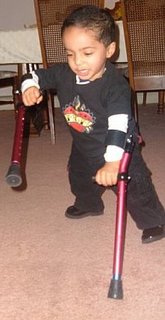
And now, at 3 years old, Jordan is the most joyful person I have ever known. He has what the veterinarian said of our Labrador retriever a few years back: joie de vivre. As he runs around with his walker, uses his forearm crutches as swords, throws himself on the floor when fighting imaginary bad guys, dances like crazy and throws his head around, “rocks out” with a guitar and sings at the top of his lungs, being “handicapped” is not something he considers or has any understanding of—and the way it looks now, he never will.

Friday, January 05, 2007

Letter to Parents Regarding “Ski Poles”

Over and over, I have seen the same reaction from other parents. These are people in my own family as well as friends of mine, not strangers. What happens is their kid takes Jordan’s “ski poles” (forearm crutches) and starts to play with them. The parent, who seemed to not even be watching what their child was doing for the past half hour, suddenly shouts in a tremulous voice, “GIVE THEM BACK TO JORDAN! THEY’RE NOT TOYS!!!”

I know that everyone thinks Jordan really needs the ski poles to get by, but if he doesn't have them for a minute, it's FINE. A few things:

First, I actually kind of LIKE it when another kid takes them and plays with them because it shows that they are normal, not anything to be scared of or think is weird. If your kids see them as something normal and maybe even something “cool,” then maybe you should, too.

Also, kids only take them when he's not using them, when they're sitting on the floor unused. They couldn't steal them out of his hands if he didn't want them to have them. He has very strong arms and hands, I’d say stronger than most kids because he relies on them more than other kids do. Also, he genuinely thinks he is a PIRATE and is very good at swordfighting. He would use the ski poles as swords to avoid having them stolen from him when he’s using them.


So then the point is that when kids take them, it's a time he isn't actually using them and doesn't need them. He is occupied with something else. He doesn’t use these ski poles 24 hours a day. He likes to stand at tables and play or sit on the floor or sit on chairs, the sofa, you know, just like other people.

So if by chance your child should kick him while he’s walking with the ski poles, steal them out of his hands and run away with them, as he lies crying on the floor—helloooo, he would not do this; he would LAUGH that someone tricked him—then yes, I guess it does warrant a tremulous voice and a “They’re not toys!!!”

But if your child does the only thing we’ve seen so far, which is take them when Jordan isn’t even using them, then just please act like it’s Jordan’s favorite toy truck—yell at them like it’s that, not like it’s some sacred object that they’ve stolen. They’re not sacred—Jordan got along before he had them, and he’ll get along even if all the ski poles in the universe are suddenly destroyed.

Bringing me to another point: Parents often say, "You're going to break them!!" If your child can bend or break metal, then I'd like to see him try!

I thought at first when I saw this overreaction by other parents that they were upset because they were picturing their own child using the crutches and didn’t want to think about that. But I have since realized that other parents probably don’t think that way. The do genuinely want Jordan to have his ski poles back. Plus, the thought probably never crosses their mind that their child would ever need to use objects to walk with. Must be nice.

But It’s not so bad, you know. It’s a great accomplishment for Jordan to be using these walking sticks. When I see him walking around the house or the mall or the yard with the ski poles, I think of the five surgeries, the first year of his life spent almost entirely in casts, and I don’t get upset that he’s using the poles. I am overjoyed to see how happy he is having this independence.

Thursday, August 10, 2006

Mobility

When I was in middle school, I remember there was this girl on the school bus I took who used forearm crutches to walk. I remember staring at her through the window of the bus as she walked to get onto the bus. She had to cross over one lane of traffic to get to the bus. It took her a long time, and it didn't look easy for her. She always seemed happy, though. That was one thing I couldn't understand then, how she could be happy when she had to walk like that. She was very friendly and would talk to people, but most people would just ignore her. Including me. I feel so guilty and terrible now as I remember that I would think to myself, "Please don't let her talk to me." Because then I'd be obligated to talk to her, and someone might see me talking to her. I didn't have many friends. I wasn't popular at all. Yet I didn't want to be seen talking to the girl who walked like that.

Then what, 20 years later, first, I had a miscarriage in May of 2002. That happened the same week I got fired from my job. Fired, then found out I was pregnant a few days later, then went to the doctor a few days after that, who sent me right in for an ultrasound, and there on the screen: a sac with nothing in it. Or nothing we could see. Nothing every bled out, and I had to have it surgically removed. I spent the whole summer at home, jobless, mourning. Luckily, we had just gotten our dog, Kahlua, a chocolate Lab, in January of that year. She was with me all the time. When I laid in bed depressed, she'd come up and lie back to back with me. It was better than a person, really, because I didn't have to say a word.

The next year, in November of 2003, I got pregnant again. Within weeks, I started bleeding. It was heavy period-like bleeding that lasted 6 weeks straight. It was the most frightening thing to me in the world at the time--going to the bathroom so many times a day, never knowing what I'd find.

I went on bedrest for 3 weeks, but I continued to bleed. The doctor said what will happen will happen, and bedrest really wasn't going to do anything. I went back to work, still bleeding. It stopped on January 18, 2004. I don't usually remember dates too well, but that one I do. The baby was fine. But it wasn't until March that I bought one thing for the baby. I was 5 months' pregnant by that time, and my husband and I went to Target and got a few little outfits and stuff. I remember these little light green onesies we bought. They had palm trees on them and giraffes. They were sooo cute. I let myself trust that the baby was going to be okay. Finally, I let myself believe it.

After Target, we went out to eat that night, to celebrate. I saw an ex-coworker there. She was from the job I got fired from. So that brought all of that back. We liked the restaurant--they had freshly baked, hot chocolate chip cookies with cold milk for dessert! So a few weeks later, we went back to the same restaurant with some friends. I remember waiting for our table and seeing this group of two couples with their kids. One of the kids used those forearm crutches. He was about 5 years old. I remember looking at the parents, noticing how they talked so nonchalantly to each other, laughing, chatting with each other, barely watching their son as he basically ran around on those crutches. I wondered how they could be so casual about it, seemingly not even thinking about how their son was getting around.

Now when people stare at my 2-year-old son when he is using a walker, I am the one acting casual. I am the one who thinks it's great that he can get around on his own. I am not the one staring, wondering how those parents do it. I am not the kid staring at another kid using crutches. He's my kid now. And I can see why that little girl on the school bus was so happy, why those parents were laughing and nonchalant. They probably went through a lot to get to that point, and they were glad for the walking, even if it was with a "device." The independence that that walker gives my son and those crutches gave those other kids is what is important--not that they do it in the way people are used to seeing. So when people stare at my son now, I have to try to remember that I was once one of the starers, not understanding what it's like, not understanding that it's a triumph and progress rather than something to be scared of.