Monday, August 10, 2009

The Way Other People See Him

This past week we were on a short five-day vacation at the beach and experienced three extreme incidents of rudeness and ignorance toward Jordan. The first was when I "talked back" to people staring at Jordan and was told to "go to hell," as if I were in the wrong. Second, a man tried to give Jordan $5, I guess because he's a charity case. Third, a woman with a cross around her neck told Jordan, "BE HEALED." I told him:

You are perfect as you are. Nothing about you needs to be healed.

Most of the world sees him as someone to be gawked at, given charity, in need of healing. But this is how I see him:

Photobucket

Photobucket

Photobucket

Photobucket

Photobucket


Can anyone else see this??

Sunday, July 12, 2009

5 Years Ago Tonight


5 years ago tonight, my beautiful boy was born.

5 years ago tonight, the nurses gasped and the doctor grew distant and silent. Someone muttered, "There's something wrong with his legs." I shouted, "What's wrong with him?" but everyone had their backs to me.

5 years ago tonight, my husband looked at our baby for the first time and thought, "He's going to be a champion!"

5 years ago tonight, my husband held our baby and smiled for the cameras as the doctor told me: "Mental retardation, heart problems, and die before age 1."

5 years ago tonight, my mom would not leave the hospital until we decided on a name. I knew she didn't want him to die without a name. We named him Jordan.

5 years ago tonight, after all the parents, in-laws, and brothers were gone, after I was passed out from the morphine, my husband took our new baby into the hospital room and in the dark uncovered his legs, crying with worry but also trusting in God.

5 years ago tonight, our lives changed in the most profound way as we started on our journey with the most wonderful little boy.

HAPPY BIRTHDAY, JORDAN! We are privileged to have you in our lives and are so, so proud of you.


Wednesday, April 15, 2009

Field Trip

I saw something really interesting at the hospital yesterday. Jordan and I were there for an ortho visit, and I noticed a group of about 15 kids around kindergarten age who looked to be touring the hospital together. I knew they weren't patients because I saw them boarding a school bus to leave. I really do hope they were there visiting a kid from their class who was a patient there. However, my first thought was that they were on a field trip. "How nice that this is their field trip," I thought, "rather than their real lives."

Some kids are only visiting this life of hospital visits. Some kids go through life with runny noses, ear infections, and nothing more. These kids can visit a children's hospital as outsiders, be led around by a friendly hospital volunteer, maybe try on a doctor's white coat, listen through a stethoscope, maybe have a few laughs over trying on non-latex gloves and blowing them up like a balloon. They can learn about doctors and medicine the same as if they were visiting a museum.

Other kids are constant patients undergoing testing, surgeries, PT; being fitted for braces, wheelchairs, walkers, crutches. Some kids' lives have stopped altogether as they undergo chemotherapy. Strange how different life can be if your roll of the dice is to have a chronic medical condition. I would have loved to save Jordan from this life of hospital visits and therapies. But somehow we know something the field trippers don't know--how fragile life is and how thin the line is between them and us.

Saturday, March 07, 2009

It's Not Contagious

Today was a beautiful day, so we headed out to the playground. We went to Jordan's favorite one (and mine!), Everybody's Playground. It's an accessible playground--people with walkers, crutches, and wheelchairs can get right up onto it easily because of the wide ramps. We had Jordan's birthday party there last year and are thinking of doing it again this year.

The Stare Patrol, as we call it, is always out in full force there, and I try not to be bothered by it. But it is amazing the different reactions to Jordan--the ignorant, the rude, and the outright bizarre!

The parents my age don't stare that much or seem overly concerned with Jordan, but some of the kids stare and ask questions. I overheard two kids discussing Jordan's crutches. The crutches were lying on the ground near them, and they looked like they really wanted to touch them. The boy said to the girl, "They're fake," pointing to the crutches. He reached out slowly to try to touch them, probably thinking I wouldn't notice. When I glanced over, he said, "Uh, does he need these?" I said, "Yes." Then Jordan grabbed them and ran away, and the girl said, "They're real."

Then this was pretty cool, actually--Jordan kept using his crutches as "guns," so one boy in particular really wanted the other one to also use as a gun. My husband said to him, "They're not toys," but it was clear that they are to Jordan!

The older women, on the other hand, are the worst. First, the pity approach: I heard one grandmother say, as Jordan ran off using his crutches, "God bless him." Gee, thanks. God bless you and your grandchildren, too. Believe it or not, Jordan doesn't need any more blessing than anyone else.

This other older woman really got my ire up. Her grandson was a few years older than Jordan and kept following Jordan around. They were having fun playing together. Often kids do just come up to Jordan, and Jordan leads them around. He is especially commanding on the playground, and even more so on one like this with a fake pirate ship on it! He was leading this kid around saying they were looking for treasure, etc. But the grandmother was not happy about it. She told him a few times to be careful. Then she called him over to her and stage whispered, "I told you, go over there and play by yourself." He ran off but minutes later was playing with Jordan again. I saw him sitting on one side of the pirate ship, but when he saw Jordan, he got up and moved to sit next to him.

I told my husband I was going to say to that woman, "It's not contagious." I can understand her not wanting her grandson to be the one to knock over the "poor crippled boy." Ughhghg. But to ban him from playing with my son, when all the kid was doing was treating Jordan like any other kid? Strange, and if you think about it, truly terrible. Heartless? Selfish? Fearful? Is my beautiful, joyful boy someone to be feared? Or as that kid today realized, someone to conquer the playground with?


Monday, March 02, 2009

Thrown in the Rubbish Heap

I noticed earlier today that I had an anonymous (of course!) comment on one of my past posts saying something like, "Why do optimistic people like you write things like this? You should throw your baby in the rubbish heap."

My first instinct was to just delete this comment (and I did). This is MY blog, so this person doesn't get an equal forum with me. And I thought I should just try to forget it, not dwell on it, certainly not let such a thing take up a moment of my time or be seen on MY blog.

I certainly am trying not to let this comment hurt me. This person does not know me or my child (eg, anyone who knows me would truly get a belly laugh out of my being called optimistic). This person must not be a parent at all or could never dare to think or write something like that about someone else's child. But it is this attitude that I worry about for Jordan when he's out in the world by himself someday. He is just someone's "trash," not a person? Not a valuable part of this world just because he uses a device for walking?

That the person wrote "rubbish heap" makes me think this was probably a British person, so I think back to Gail Landsman's wonderful book Reconstructing Motherhood and Disability in the Age of "Perfect" Babies . She believes that one reason Americans stick with their children with disabilities rather than throwing them away like has been done in so many cultures throughout time is because of Americans' belief in the underdog, in the "against all odds," pull yourself up by your boostraps story. And nowhere is this idea more potent and prevalent than right in the area where I live, right outside of Philadelphia, PA, home of Rocky Balboa.

The reason I bring this up is because I've often struggled with the notion in disability studies that "hero or villain" is a harmful concept. I do agree, of course, that people with disabilities shouldn't be viewed in the villain role, as in the reaction to Dick Cheney's use of a wheelchair at Obama's inauguration. And I do agree that the "inspirational story of the week" wears a bit thin, too. But as a parent of a child with an impairment, I am exceedingly inspired by him every day. Is that okay because it's a "parent thing?" Do all parents feel this way?

Furthermore, is this inspirational thing what has kept us Americans from abandoning our disabled infants, keeping them, helping them to be the best they can be, just like we do for any other child? So is it a good thing to keep these inspirational stories coming?

Landsman also says in her book that mothers of children with disabilities—American women—often try to create a narrative to deal with their children's conditions, creating kind of a linear "movie" of their lives as a progression. I noticed that in myself, too, especially in the short movie I made of Jordan's life when he was 3 years old (see top left of this page for a link to it). Called "Jordan's Life So Far," I essentially plotted out his life as a linear progression from birth with clubfeet, dislocated knee, etc. through surgeries that "fixed" him to normalizing images of him doing everyday things that any kid does—playing the drums, painting, etc. I noticed shortly after I created it that this is what I did—presented his life in an "inspirational" way that is expected in this country. Is this so bad?

What I do think is bad is feeling the need to even do this, to make him not just normal but above normal. Would I idealize him anyway because he is my child? Or do I truly see him doing things I don't think I could do—be happy in the face of surgeries and not being "normal?" It's strange to me, too, as someone who never wanted to be "normal" or "average." I wanted to be different. I wanted to be extraordinary but never was. Now that he is different, am I trying to make him ABOVE everyone else, present him as EXTRAordinary?

But back to my original point about the anonymous comment on my blog. My first thought was that it's people like that who should be thrown in the "rubbish heap," not my beautiful boy. But wouldn't it be better to say that whether we are "normal," "disabled," "extraordiary," "impaired," or even a rude anonymous blog commenter, none of us should be thrown away, that all of us have value?

Thursday, February 12, 2009

Disability Blog Carnival #53: Pot Luck


With the topic Pot Luck, I hoped to receive a lot of varied submissions. And I sure did! True to the topic, the submissions were all over the place! This was my first blog carnival, and it was so much fun putting it together! I hope you enjoy the offerings here.

(Mis)Perceptions and Labeling
To start it off, Andrea from Andrea’s Buzzing About talks about empathy in people with autism in You Just Don’t Get It. She writes, "If you cannot see that autistic people do indeed have empathy, then possibly you are not perceiving their distress, identifying the feelings being experienced, discerning probable causes, and being able to identify with such situations."

Laura at Touched By an Alien: Life as I Know It writes about the controversy of labeling in order to receive community resources. She rightly asks if services should be more geared toward the individual rather than based on a label.

Cheryl writes If You're a Tard and You Know It... about the book The Short Bus: A Journey Beyond Normal by Jonathan Mooney. She recommends this book and its great disability pride sentiments and from the sound of it, just because it's fun.

Accessibility: IKEA, Pubs, and Dick Cheney’s Wheelchair
Accessibility was on several people’s minds. Lauredhel of Hoyden About Town was at first impressed by IKEA’s accessibility—until she tried to leave the store!

Emma at Writings of a Wheelchair Princess tells us about recent complaints she has written about accessibility issues she’s encountered. “I will always be making complaints because how else will the world change?” she asks.

I also received a few thought-provoking posts about Dick Cheney’s use of a wheelchair at the presidential inauguration last month. Laura writes about Cheney’s Villainy: Nothing to Do with His Wheelchair. She writes: “We don’t need another villain in a wheelchair. A villain he may be, with shared responsibility for torture, repression, and all kinds of other crimes against humanity. But the wheelchair has nothing to do with it.”

Liz also covers this topic at Deconstructing Cheney's De-Inaugural Wheelchair. She writes: “How bitter, but how very expected, that the top levels of our own government, the most powerful men around, can't pull it together to obtain a halfway decent wheelchair and decent access, for one of their own. That exposes the deep, deep ignorance in our country about access for people with disabilities, and how far we have yet to go.”

Pity and Incompetence
At the blog Coral and Opal, there is a good commentary, Some Laughs Are Cheaper Than Others, about recent comedy skits about David Patterson, governor of New York. Even humorous skits should not “further the misconception that blindness is part of incompetence,” they write.

Speaking of demeaning views of people with disabilities, we must mention our old friend Jerry Lewis! The excellent blog The Trouble with Jerry has been cataloging Lewis’ use of pity to raise money for muscular dystrophy research. They recently posted the Academy of Motion Picture Arts and Sciences’ response to a letter opposing Lewis’ receiving a humanitarian award. Equating Lewis’ patronizing and pity-based approach to people with disabilities to "some scratches in the paint job” on a Lamborghini, the Academy just doesn’t get it and is sticking by its intention to give Lewis the award. Can’t say I’m surprised. . . .

Honoring “Genuine Inspirations”
I received a few posts on people with disabilities who have been true inspirations. I know, I know, but check out Romeo’s post on Tom, “the most famous autistic savant of all time,” who was a musical genius.

PhilosopherCrip talks about a “genuine inspiration”—I like that!—in a “heartfelt remembrance of an activist and a ‘force,’” his friend Annie who recently passed away at age 24. Annie’s philosophy of life was “Embrace diversity. Educate your community. Empower each other. Love life.” A little bit different than that Lamborghini with scratches on it above, huh?

And who isn't the biggest inspiration to us parents than our children? I received some great posts from mothers who blog about their children. Sally at Maggie World talks about her daughter’s communication abilities at The Sounds of Silence. Since getting her trach, her daughter communicates without her voice. Sally misses Maggie’s laugh and how she used to say “mama.” “We communicate fine without that one word, but it was always nice to hear,” she writes in his heartfelt post.

Ricki’s mom at Beneath the Wings gives us several thought-provoking posts about life with her daughter. On one occasion, she found running away to be the best response. It’s better on the nerves and the eardrums, she writes. She tells us about Ricki’s shaking off an annoying offer of help with something she could do perfectly well herself, thank you. On yet another occasion, Ricki’s mom found herself teaching a future special ed teacher a lesson about rights and respect . And last, she deals with teachers who let Ricki get away with murder. All in a day’s work for a mother, huh? :)

Miscellaneous
Heather from Learn-gasm provides a nicely organized list of the top 100 gender studies blogs. Anyone have a list of top 100 disability studies blogs?

A few posts discussed specific conditions and how they should or should not be treated. Dean at The Back Pain Blog talks about Herniated Discs and the Catch-22 of Rehabilitation. Rebuilding a person’s back isn’t easy, but Dean says it can be done.

And Ettina of Abnormaldiversity talks about side effects of behavioral treatments. She also reports on a case in Canada concerning a woman with Asperger’s. Ettina writes: “Much as many people would like it, being nasty and verbally abusive does not take away your human rights.”

Barbara at Barbara's Tchatzkahs tells us about how the topic of autoimmune diseases is pushed under the rug even though these disorders are so prevalent.

Alicia at Temporarily Disabled writes about warning signs her body was giving her when she was just in the fourth grade. This is her first entry in what should be a great blog. She tells us to stay tuned; I know I will!

Eminism.org reports on a recent symposium at the University of Washington on the “Ashley treatment,” or "growth attenuation". No disability rights activists were present at the conference, which is quite disturbing.

Terri at About Partners in Policymaking writes about participating in New York State Partners in Policymaking (NYSPIP). She tells us that PIP covers “cutting-edge ideas and principles,” and the best part of the program is the relationships that are built there. PIP exists in most states, so look into it!

Keeping Hope Alive
I’ll end with some optimistic thoughts. At Life of John , John discusses keeping hope alive about finding that special someone through online dating. Good luck, John!

Frances tries to look on the bright side about the current financial crisis in her Independent Living Journal. She writes, “… perhaps now it's time to back the people who don't fit into the narrow stereotypes of traditional success, and see whether imagination and good-will can get us a bit further than recent economic theories have.” Here’s hoping!

And finally, Terri at Barriers, Bridges and Books shares the post Impossible? about her hopes that our new president can make some progress for people with disabilities.

Phew! All of these posts gave us a lot of food for thought, and I hope everyone had their fill (I know, pretty bad)! Thank you for all the submissions. I think this topic really worked out well—broad enough to be able to include tons of different topics and experience many different blogs. But wait, don’t go away too fast—anyone going to help me with the dishes???

Sunday, January 11, 2009

Announcing the Topic for Disability Blog Carnival #53: POT LUCK

The latest Disability Blog Carnival is up at DCB 52: Things That Are Therapeutic. There are a lot of great posts, so check it out!

I am hosting the next carnival, and I want to announce the topic: Pot Luck. Thanks, yanub (of Yet Another Never Updated Blog), for your feedback that a broader topic might invite more participants. And the crazy holiday season is over, so I’m sure you all have your blogging caps on! You can submit any kind of post you want for this one. Hopefully it'll open up a lot of great discussions, too!

Submit your posts for the broadest topic of all, Pot Luck, by February 9 for the February 12 carnival! I look forward to reading all your great posts and hosting the carnival—it’ll be my first one! :) I hope it'll be a good one. As yanub said, “When everyone brings their favorite dish, no one goes away hungry!”

Late addition:
A few people have indicated that they aren't sure what "pot luck" means. Maybe it's an American thing??? So, here's a definition from Dictionary.com:

pot⋅luck –noun
1. food or a meal that happens to be available without special preparation or purchase: to take potluck with a friend.
2. Also called potluck supper, potluck dinner, potluck lunch. a meal, esp. for a large group, to which participants bring various foods to be shared.
3. whatever is available or comes one's way: With fluctuating interest rates, homebuyers are learning to take potluck with the banks.

Basically, this carnival includes whatever you have, whatever you want to submit, anything goes!

Tuesday, December 30, 2008

Things That Are Therapeutic

I have been seeing a psychologist since my son was born. There, I said it. I was originally diagnosed with adjustment disorder.

Adjustment Disorder is an abnormal and excessive reaction to an identifiable life stressor.

I don't agree that my reaction to being told my baby was going to die before age 1 was abnormal and excessive. But nevertheless, I do agree that adjusting to my new life and expectations was stressful and difficult. Since then, I have found other ways to deal with stress (although I continue with my therapist!! :).

I didn't always use the "right" kind of therapy. I threatened my drug and alcohol counselor husband that I was going to start drinking. But I've never been much for alcohol, so that didn't work out. What did work out for a while was "retail therapy." When Jordan was a baby, I thought if he was going to have surgery, he deserved all kinds of expensive toys and cute outfits, even if we couldn't really afford them. And I deserved some new clothes, music, books, too many dinners out....

Since then, I've come up with some more effective and less destructive ways to deal with stress. Getting involved with disability studies has been therapeutic for me. It is no longer just my child, no longer just me as a parent. Disability studies has given me a wider perspective and a community.

I also have an "alone night" every week that has been therapeutic for me. I finally realized that my husband has one night out a week playing Dungeons and Dragons, of all things, so I should have a night to myself as well. I usually have something "bad" but delicious for dinner and then go shopping and to the movies. I don't like seeing any sad movies anymore or even many "dramas." I like purely escapist, silly movies.

The other usual things are also therapeutic for me: music; writing; a long, hot bath; putting on a nice-smelling lotion; getting a nice haircut. And actually, spending time with my son is therapeutic. It has never been him that I've been trying to escape from, that has caused me to need something therapeutic; it's the rest of the world, with their stares, their prescriptions, their red tape. Another parent told me early on, "You'll find your new normal." I think after 4 years, I finally have. I think all along I've been adjusting to making this a normal life for us.

Friday, October 31, 2008

Looking for STARING STORIES

I'm working on a paper about parents of children with disabilities, specifically parents’ reactions to STARING. I want to explore parents’ reactions, dealing with stares, how it makes them feel, how they react, if they intervene and if so, how, and so on.

If you have any stories to share, please email me at twxee@aol.com. I will not use your or your child's real names, of course!

Also please feel free to pass this around to anyone else you think can help!!

Tuesday, October 21, 2008

Capacities and Capabilities

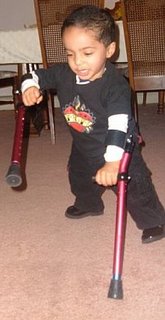
A strange thing about Jordan—or maybe the least strange thing about him—is that whatever people think he isn’t capable of doing is what he wants to excel at. He was born with multiple orthopedic issues such as dislocated hips, a dislocated knee, club feet, and the ability to only move one of his toes (the big toe on his left foot). He walks with a walker or forearm crutches (we call them “ski poles), and he wears braces.

He is very smart and verbal and always has been. But what he wants to excel in are physical things. He throws himself around, he fights with swords, he does stunts on his walker. He is already planning his fifth birthday party—9 months away—as a wrestling party, more specifically, a “smackdown” party. It’s going to take me these 9 months to convince him to have a different theme!

Over the summer, we went to a birthday party for a girl in his class. It was at one of those “bouncetown” places. Right when we got there, the birthday girl’s mother came over to us and said, “There are some things over there that Jordan can play with!” pointing to the “soft play” area for infants. There were about four little foamy pillow-like things for babies to play with on the floor. “Yeah, sure,” I thought. “Just watch him.” He then went and climbed up a huge slide using only his arms, used a rope to climb up another one of the bouncy things, and truly kept up with all the other kids.

Recently when we were going through a lot of stressful things with both my husband’s and my family, it was affecting Jordan at school. He “kept to himself” in the classroom, the teacher told us. But still, out on the playground, he was the usual leader, getting his classmates to trail after him while playing “cops,” and “arresting” nearly every kid on the playground.

Last week they had a bike-a-thon at his school to benefit St. Jude’s. We brought his arm-powered Amtryke in for him to use. He needed help getting around the track, but he told us he “won” the bike-a-thon. I don't want him to be deluded about his physical skills, but I do want his confidence to last.

“I’m wiggling my toe!” he said to me the other day. That was his first acknowledgement about the movement in his toes. But the interesting thing—he didn’t say, “I can’t move nine of my toes.” It was that he can move one of them. The old clichés apply—he’s teaching me more than I’m teaching him. How am I supposed to reconcile not liking it when people say that he is “inspirational” with my own feelings that he does inspire me? He does reveal things to me every day. I feel like I'm not doing any of this; I'm just along for the ride, his loyal follower.

Monday, September 15, 2008

Jordan's Dream

"I had a dream that they let me hand out the forks at school." That's what my 4-year-old son said yesterday.

"Do other kids hand out the forks at school?" I asked him.

"Yes."

"Do they take turns?"

"Yes."

"And you don't get a turn?"

"No."

OH, HELL NO.

His school, which started out great, has gone downhill lately, with teachers leaving all the time. It seems like every few weeks someone is gone and a new teacher is there. It's hard to keep up. Ever since this has been the case, he hasn't liked school as much. He is a very sociable kid, and what went from enthusiasm earlier in the year has turned into the opposite. Changing teachers so much is really affecting him, it seems.

He LOVES to help around the house. He loves doing the dishes with me, and I give him the heaviest pots to put away, the glass bowls, everything (except the sharp knives!!). He feeds the dogs and sweeps the floor. Of course, he cleans up his toys. So it's his DREAM to help out at school. Could my heart be breaking any more than this???????

My husband and I went in to talk to the teacher today. She said, "Okay, I'll do that" and went back to writing something. A weekend full of discussions about how to handle this, what to say, how to explain that we EXPECT INCLUSION, boils down to a dismissal by the teacher. "Are you satisfied with that?" I said loudly to my husband. "No," he said, and we continued to talk to her. He has a bag on his walker that helps him carry things. We expect him to be included just like anyone else. "Okay, I'll do that today," she said. TODAY? No, this should be an overall thing. I almost snatched up Jordan and took him out of there. He sat at a table nearby and was listening to what we said to her. He is still at the stage where he thinks his father and I can solve all the problems of the world. IF ONLY.

We talked to the co-director of the school, and she said she would observe the classroom today and then get back to us and then tell the teacher what changes she needs to make. This seems to be under control for the moment. We would switch him to another school, but if we do that every time he is discriminated against, would we be switching schools constantly? Can we do anything to get them to change? Do they need reminders from time to time? Or is it IMPOSSIBLE??????????????

He is 4 years old now. I do not look forward to all the fights we will have to keep having over his education for the next 14 years. But believe me, I am up for the fight. He is going to know that he will be included. He is going to DEMAND to be included. He is not going to be like me as a kid, shy and letting everyone walk all over him. He is going to continue to see us demand equal treatment, and if he doesn't get it, they are going to see us, hear us, over and over until they get it.

Postscript: Jordan gave out the forks today at school. It makes me cry to think about this simple thing being his dream. It also makes me cry that someday soon I won't be able to solve everything for him so easily. My boy is growing up--is the world ready for him???

Tuesday, September 09, 2008

Baby Feet

Baby feet. When you think of them, you think of something beautiful and amazing—tiny yet somehow strong, envisioning all the places that newborn baby might walk and all the things he might do in his life. A new beginning with new, soft, beautiful, adorable feet to use on the journey. You just want to kiss those cute wittle toes.

It all starts with the baby shower. The gift tags, gift bags, greeting cards—so many of them have pictures of tiny baby footprints on them. The mother-to-be might get a kit to press the baby’s feet into clay to make a keepsake of the footprints. Special frames are used in anticipation of the big event—the baby’s birth and the footprints, which can be framed for posterity or put into an album. 10 perfect fingers and 10 perfect toes. These frames often come with little poems:

Two little feet, ten little toes,
Leave their impressions today.
Soon they will wear two little shoes,
And be running
and jumping at play.
Two little feet, too little time,

Before they are walking to school,
Kicking a rock, or skipping a rope,
Wading a
puddle or jumping a pool.
Two little feet, one little child,
Will soon go the
ir own way,
But footprints in my mind recall,
They stood here yesterday


Or short and simple:

Little hands, little feet
Pure and precious, and Oh So Sweet!


A baby makes footprints in our hearts
that never
dim or fade.

Where ere a baby's little footprints are found,
There is precious and hallowed ground.


The pitter patter of little baby feet
is music to the ears and ever so sweet!


In parenting magazines, it seems that every single baby and toddler is shoeless and sockless. I did a little study of it recently, and it’s hard to turn 5 pages without seeing some baby feet! No one wants to cover up those precious little toes!

It was into this world that my son, Jordan, was born, a baby with clubfeet along with a dislocated knee and dislocated hips. It was hard to look at his little footprints on the piece of paper. The doctors immediately started saying how he “wouldn’t be much of a walker,” and they began casting his feet when he was 9 days old. He had two surgeries on each foot and one on his knee, all in the first 15 months of his life. Plus, physical therapy, braces, walkers, crutches. Instead of cute little socks or letting him go barefoot, my baby was in casts for almost the first year of his life, and after that, braces almost 24 hours a day, including the brace with a metal bar between the feet. When he was around 4, he had more casting done to align his feet again--with his condition, his feet keep trying to go back to how they were when he was born. They keep trying to adjust his feet until he stops growing, and then they will stay where they are when he's an adult.

When he was about 2 months old and all of this was so new to me, with so many doctors appointments and so many dire prognoses, one day we took a break and went to Babies R Us. We went into the nursing/changing room in the back. I loved that they had this little room set up for us. It was so comfortable, with sofas, a changing table, room to just sit back and relax. Feeling relaxed for the first time in a while, I looked up from feeding him for a minute, and right in front of us on the wall was a huge probably 5 foot by 8 foot poster, a close-up of baby feet! I couldn’t escape!

Many times seeing those photos of the cute baby feet--and even the feet of my friends' and relatives' kids, who always seem to go around barefoot--tore at my heart. Why was it so easy for everyone else? Why were these babies crawling and then walking, not using any devices, not using any braces, when they were still SUCH BABIES, while my son talked like a professor so early, gave us “lectures,” as he called them, at age 1½, knew all the words to book upon book of nursery rhymes before he was 2, started sounding out words at age 3?

Someday I'll jump through puddles,
Take a stroll or run a race.
Someday I'll walk across the street,
Or maybe walk in space,
Someday I'll scale a mountain,
Or I'll join a ballet corps.
Someday I'll walk a tightrope,
Or explore the ocean floor.
Someday these feet will do some things,
That only heaven knows,
But for today they're happy
Just to wiggle all their toes.


Some babies can’t wiggle their toes and will grow up never wiggling them. The only toe Jordan can move is his big toe on his left foot. He has no movement at all in his right foot. But he does jump through puddles—using a walker and braces. He does whatever he wants. He doesn’t know about the stress this has caused me, having him not fit into the “mold” of the “perfect baby” that is drummed into our heads. He is just himself—rough, tough, sensitive yet strong, hilarious, and “all boy.” I now look back at his baby footprints and see something different—the feet were so tiny and were not aligned perfectly, but they are the feet of MY little boy.

Just 2 weeks ago, he took his first steps without his walker or crutches. I was happy about it, but suddenly I realized that it didn’t mean as much to me as it once would have. I know now that the important thing is that he can get around independently, and whatever device he has to use to do that best is okay with me. The doctor is now talking about another surgery for Jordan's feet and knees. I am looking into nonsurgical options because I now wonder if all of this has been too much, trying to align things to make them LOOK good. But if they're working for him... It's a hard balance. I don't want there to be any damage to his knees or feet from walking the "wrong way," yet I don't want him to go through anymore surgeries if they're not totally necessary.

In the meantime, the doctor said that the braces with the bar between them really aren’t doing any good for him anymore. So for the first time in his life, he does not have something on his feet while he sleeps. I lie there next to him in bed and make sure his bare toes are touching my leg. They feel so cozy and soft, like they belong there. The beautiful, perfect toes of my little boy.

Thursday, August 14, 2008

New Disability Blog Carnival Is Up!

The new Disability Blog Carnival is up! This is a great one with the topic "adjectives." This is my third carnival I've submitted something to, and it's so much fun writing the entries and then reading how others have tackled the topic as well. So get over there and start reading!!!!

Wednesday, August 06, 2008

Words That Sting

Sticks and stones
May break my bones
But words will never hurt me.

For this Disability Blog Carnival on ADJECTIVES, I knew I wanted to write about adjectives like “handicapped,” “crippled,” and “lame.” But this didn’t all coalesce in my mind until I was at Target today. I was in line, and the cashier, who was an older woman, was flirting with this young kid who also worked there, “razzing” him about his earring. He was a very tall and lanky and kind of awkward. After he walked away, she turned to me and said, laughing, “They call him Cripple.”

Everything came to a screeching halt. My mouth fell open. I didn’t say anything; I was too shocked. As I left, I wished I would have said any number of things to her. Maybe about my son—he uses forearm crutches and braces to walk; would she have used that “affectionate term” if she saw my beautiful boy? Maybe I should have said, “What you just said equates to nigger, thank you.” I have never said nigger out loud until today, when I described this story to my husband. Some words hurt too bad.

Just like some black people may try to do when they use the “n word,” some people with disabilities use the word crip, attempting to take back the word’s power. The thinking may be, outwardly or maybe unconsciously, "I will be the one to use that hurtful word. Then I have the power, not them." Whether this works, I can’t say for sure. I just know I don’t like “nigger” or “cripple” being used by anyone.

Handicapped is another one. There is a story that the word originated from disabled “beggars,” with their “caps in hand” looking for a handout. I know this isn’t the true origin, but still, this word bothers me. We have a disabled placard for our car, and sometimes we say we’re looking for a “handicapped space.” “Disabled space” somehow doesn’t sound right. But “handicapped” does bother me. The same thing with special needs—whose needs aren’t special to them—and even disabled. Kathie Snow at Disability is Natural writes: “’Disabled’ is also not appropriate. Traffic reports often say, ‘disabled vehicle.”

Two words that are used frequently and carelessly, often by young kids, are retard and lame. I remember last graduation season, a kid named Soeren Palumbo gave this speech about kids using the word “retard” toward his sister. He said, “Your mockery… is nothing but another form of hate."

“Lame” is also thrown around like it doesn’t mean anything or like it’s funny. A few weeks ago, I noticed that when I sent emails on AOL, a signature was being added to all my messages without my knowing it. This signature line was The Famous, the Infamous, the Lame - in your browser. Get the TMZ Toolbar Now!

I wrote to AOL complaining that I did not appreciate being forced to use this word ever, but especially when sending emails to disability studies groups and groups of parents of kids with disabilities. A tech person sent me a link to disable the signatures but of course did not discuss the political and social ramifications of using the L word.

Now, my son is 4 years old, and the adjectives that hurt him so far are nowhere near as harsh as the ones that hurt me. He is shorter than average for his age, and he has told me that kids at school say he’s “little” and “too little.” I watched him recently climbing up a blow-up moonbounce at a birthday party, and the other kids shouted, “Go, little Jordan! Go, little Jordan!” He smiled, but I know how that word hurts him. To think of how he’ll feel when he hears these other “ableist” words—cripple, lame, handicapped—flung at him… well, I just can’t describe how much my heart will break.

The only thing I can try to do is to let him know the meanings of these words and why people might use them, from my limited conception of why this is. I don't think I will use that platitude about the sticks and stones. I think he is already too advanced to believe that. So far he gets “everyone is different.” That is a frequent conversation at our house. He came home from camp the other day and said two kids there use wheelchairs. He continued: “Some people use wheelchairs, some people use walkers, some people use ski poles—that’s me!—and some people walk without anything. Everyone is different.” I think I might try to get him to change that to unique.

Thursday, June 05, 2008

If I knew then...

When my son was some orthopedic issues, I thought I knew what it meant because I had just spent the last 5 weeks of my pregnancy with a broken ankle. I was miserable and not a “good patient.” I complained constantly, my arms hurt from hoisting myself up, and I was just downright miserable. Maybe some of it was because I was 9 months pregnant and walking on one leg on crutches, but who knows how I would have been otherwise.

On top of what I already “knew,” the doctors had dire predictions for Jordan. The first one said he might have trisomy 18, meaning “mental retardation, heart problems, and die before age 1.” We took him to so many specialists those first few months. How scary is it to take your newborn to a neurosurgeon? They said he would never walk, and he would be incontinent. He had some kind of growth on his brain. The cyst on his nose might be brain tissue coming down through his nose, and any kind of little cold might lead to meningitis. It went on and on. Waking up a few days a week to take him to more appointments, only to hear more horrible things that were going to happen to him.

I recently edited a book that prepares people for taking a nursing exam. The author stresses that giving “false hope” is unethical. Nurses shouldn’t say, “Everything will be okay” when it might not be. But is it also unethical to give only worst-case scenarios? That seems to be all doctors give these days. I understand they want to protect themselves from malpractice suits. But would it be so bad to give a little hope once in a while? Anyway, can hope ever be "false?"

I wish just one doctor or other “professional” would have told me that yes, your child may have some medical issues, but above anything else, he’s a KID. The doctor visits, the surgeries, the physical therapy and evaluations become just things you have to do, and your child grows up anyway, despite everything. It really hit me one day when he was about 1 year old, a quiet moment sitting at the table with him eating French fries. And I realized this is normal. This is just our life. The regular, everyday moments had finally surpassed all the medical stuff we had to do. He was growing up despite what everyone said. He was just a regular kid, with likes and dislikes, things that scare him and things that make him laugh. The doctors never tell you that your child will learn the alphabet, make friends, love movies, sing songs, play the drums, love cutting things out of magazines, and think he's a pirate. To them he is only a medical diagnosis. If I had known then what I know now, the start to our journey wouldn’t have been so difficult and frightening.

Wednesday, February 27, 2008

Play-Doh: Life Lessons

Jordan and I have gotten really into "playing Play-Doh," as he calls it. Kneading the Doh, creating whatever we want--including mainly food, for some reason, as well as chairs, beds, and other items his mini penguin, Pengu, is apparently in desperate need of--I think Play-Doh can teach us a lot about life. Jordan often says he "can't" make a certain thing he wants to make, or he says, "I don't know how." I tell him, first of all, there is no "can't" in our house. Second, even if what he makes isn't perfect, he just has to TRY. And with practice, what he makes will turn out better each time. Playing Play-Doh is not about making perfect things; it's about practicing, learning, being creative, being funny, and even relieving tension through kneading a ball in your hands. Play-Doh IS LIFE.

Monday, December 10, 2007

“Handicapped”

When my son was born with a dislocated knee, dislocated hips, clubfeet, and missing the lower part of his spine, and they said he might never walk (might not even LIVE), I thought I knew what it meant. I had just spent the last 5 weeks of my pregnancy in a cast from my toes to my knee, after breaking my ankle when I was 8 months pregnant.

Anyone who has been 8 and 9 months pregnant knows how often you have to go to the bathroom. The first night, I had to sleep on the sofa downstairs, and with no access to a bathroom on the same floor, my dad brought over his portable toilet they use while camping. It was a Sunday night, so I had to wait until the next afternoon to get my leg casted. I couldn’t take any pain medications because I was pregnant, so I spent the night in agony on that sofa, getting up several times to use the portable toilet, which was sitting on one of our living room chairs.

After getting my cast on, I managed to crawl up the steps to our house backwards, but then I had to haul myself up into a desk chair with wheels on it. We called it the FDR’s wheelchair because of how old and rickety it looked. But other chairs were too high for me to hoist myself up into. So I had to use my arms and the non-broken leg—I couldn’t put any weight whatsoever on the broken ankle—to lift up this heavy body I wasn’t used to. My family wasn’t giving me any help, really. They wanted me to “keep active.” All I thought about was keeping the baby safe.

I had to convince them to let me have a wheelchair; they thought I should walk on crutches so I’d be more active. But after falling down stairs and breaking my ankle, I wasn’t very confident about using crutches. I had never used them before, and I thought being 8 months pregnant, after already falling once, it was not the time to learn.

This late in pregnancy, it’s hard to sleep anyway, and now they say you shouldn’t sleep on your back when you’re pregnant. So, I had to sit up in bed with my leg elevated. It was hard to sleep, too, with the number of bathroom trips I had to make. The first week, before I had my wheelchair, I had to walk down the hall in the middle of the night, about once an hour, on crutches, scared I was going to fall again. Then when I did have the wheelchair, it was hard to move myself from the bed into the chair because there wasn’t much room for it next to the bed. When I was in the chair, I would wheel down the hallway, and then because the wheelchair couldn’t fit in through the bathroom door, I had to stand up at the door on one leg, grab my crutches, and take a few uncertain steps on them before plopping down as gently as I could on the toilet (ie, not gently at all), worried with every movement that I’d do something to hurt the baby.

To get into the shower, I’d have to step over the edge of the tub and then shower on one leg, and I wasn’t comfortable doing that. Also, we never realized we could put a plastic bag over my cast. So, I took sponge baths. I sat on the toilet, put a few towels over my cast, and then bathed from the water in the yellow bucket that I’d gotten as a baby shower gift. (The bucket had been the “gift basket,” and inside were all kinds of cute baby bath things such as washcloths, baby lotions, and baby shampoos.) I’d wash my hair and then rinse it by leaning over the tub and pouring a pitcher of water over my head. I took my time with these sponge baths; it was one of the only times of day when I felt fresh, clean, and comfortable—and not afraid that I wasn’t going to fall down (mainly because I was already sitting down)!

During those 5 weeks, I rarely went out, mostly to doctor’s appointments. The first time my ob/gyn saw me with the cast, hobbling out of the bathroom on crutches, she looked shocked and shouted, “You can’t deliver a baby LIKE THAT, with THAT on your leg!!!”

The day I got the wheelchair, my dad insisted on taking me out to the movies. I really didn’t want to go, but he thought I needed to get out. What I remember most about it was hard it was to use the bathroom. It was hard to open the doors to get into the bathroom, and then when inside the stall, the handrails on the walls were very wobbly, and some were coming off the walls. And the floor was slippery when I tried to haul myself from the wheelchair onto the toilet, and of course I was terrified as usual that I would fall and hurt the baby.

Also, he dropped me off at the door to park the car, and when I went to the ticket booth to buy our tickets, the man working there took a while to notice I was there because I was so low down in the wheelchair. Then he barely looked at me. It might not have been me, but that was how I perceived it, that he was “looking down on me” because I was in a wheelchair. And doors were slammed in my face whenever we went to the movies. No one would stand there and hold a door for me.

I was due to get the cast off 1 week before having the baby. Of course, he came a little early, and I still had the cast on when he was born. He was turned the wrong way, so I had to have a c-section. The mood in the delivery room was cheerful until he was born, and then it grew very quiet. Then I heard mutterings, “His legs… something is wrong with his legs….” After that, everyone was silent, and my husband went over as they cleaned him off, and all their backs were to me. “What’s wrong with him?” I yelled over and over. They seemed miles away from me but were only feet away. I tried to reach out to my baby, but my arms were pinned down. My legs were literally paralyzed from the epidural, and I couldn’t walk anyway with my leg in a cast. They let me glance at him for a split second, but of course not hold him, as they took my husband out and they stitched me up.

“What’s wrong with him?” I finally got to ask my husband.

“Just a little something with his legs. No big deal,” he said, as they pushed him out of the room. I later learned that while I was in there worried out of my mind, he was in the hallway holding our baby, Jordan, and showing him off to the grandparents. They took a lot of very smiley photos as I was alone in the recovery room, being told my baby probably had trisomy 18, meaning “mental retardation, heart problems, and die before age 1.” The doctor who said that then left me alone again, questions unanswered, with me on drugged out and shivering under a hot blanket.

They took Jordan away the next morning to a NICU about 40 miles away. Mike, my husband, came and stayed overnight with me every night that I was in the hospital, but he spent many hours of the day and into the late night there with Jordan in the NICU, reading him books. And holding him and feeding him, two things I was supposed to be doing. Not him. Me. But there I was worthless and helpless in a hospital bed 40 miles away while doctors ran countless tests on my baby and nurses took care of his most basic needs.

It still kills me to look at the first photos of him, taken when he was in the NICU. He had scratches all over his face because no one cut his nails, and he didn't have those little mittens to wear. And he was wearing a donated outfit because my husband didn't think to bring him anything to wear. I know he was busy running back and forth between hospitals. But instead of Jordan's wearing the adorable Winnie the Pooh outfit I had picked out for him to wear as a newborn, he was wearing a donated outfit, with scratches on his face, no mommy to take care of him.

One of the major things you’re supposed to do after a c-section is stand up on the second day after surgery. For me, they had two young physical therapists come in to help me. The pain was excruciating—but not as bad as broken ankle had been—as I stood up and these two young girls stared at me, dumbfounded. “That’s it,” I said, “I’m sitting down now.” Later that day they sent in a very energetic, muscular male PT, I guess who was supposed to motivate me. He didn’t. On maybe the third day, they let me take an actual shower, the first one I’d had in 5 weeks. They put a plastic thing over my leg, the nurse left me alone, and I just let the water rain down over me for nearly 45 minutes. And with less fear of falling now that I’d had the baby, I did start to walk on the crutches a little bit, and I remember so clearly that moment as I walked into the shower for the first time: I thought, this is what my baby is going to experience his whole life—this helplessness, pain, fear, sorrow, and anger. This is what being “handicapped” is all about, and this is what his whole life is going to be like!

Little did I know the powerful person my baby was. I was terrified to go into the NICU, but seeing him there for the first time, he looked so healthy lying next to the tiny babies in incubators. He had great coloring, was active and alert, and I could have sworn, he stared into my eyes already, responded to my voice, and knew who I was. And he looked like he knew something. At 2 weeks, old, he smiled during his first bath in the kitchen sink. At 6 weeks old, his Gymboree teacher told me, “He has an old soul.” At 3 months old, he laughed his first big laugh during an appointment at Shriners. He had five surgeries before he was 18 months old, and all of them were much harder for me than for him.

When he was just under 2 years old, he was a ringbearer in his grandfather’s wedding. When they asked us if he could be in the wedding, he couldn’t even walk yet. On the day of the wedding, he had been walking with his walker for only about 2 months. The other ringbearer, who was about Jordan’s age, had no trouble walking, but he cried his eyes out and had to be carried down the aisle by his mommy. Then Jordan confidently walked into the church all alone, looking like a little gentleman in his tuxedo, and shouted, “Hello, everybody!” He dashed down the aisle, taking his job very seriously, and sat in the front row of the church and “read” the church bulletin. The other kid continued to sob during the entire ceremony.

And now, at 3 years old, Jordan is the most joyful person I have ever known. He has what the veterinarian said of our Labrador retriever a few years back: joie de vivre. As he runs around with his walker, uses his forearm crutches as swords, throws himself on the floor when fighting imaginary bad guys, dances like crazy and throws his head around, “rocks out” with a guitar and sings at the top of his lungs, being “handicapped” is not something he considers or has any understanding of—and the way it looks now, he never will.

Wednesday, May 09, 2007

The Lamb Chop Incident

The other night while we were out at dinner, we encountered the usual gawkers. As Jordan walked with his walker, almost everyone in the restaurant craned their necks to stare at him, shouting the usual things like, "You're doing great!" How do THEY know he's doing great? Maybe he is declining, rather than improving. They have no idea.

Then, when we were in the store, this couple behind us in line saw Jordan grabbing the Lamb Chop dolls. I told him no, he couldn't have one. I was buying him something else. The man behind us said, "Aww, you like those Lamb Chops?" It was then that I knew, and cringed--they were going to buy one for him. I tried to get us out of there fast, but the woman came running up to us and gave him the Lamb Chop. I wish I would have said, "No thank you" graciously. But I was just cringing, unable to come up with a good spur-of-the-moment reply. I told him to say thank you, as I gritted my teeth.
The woman thought buying him something gave her permission to duck down to his level, ask his name, and touch him on the head, saying, "GOD BLESS YOU!" in the most dramatic voice. He said his name was Jordan, and then he turned to continue walking. What a marvel he must have seemed to them!!!!

They were behind us, so nicely holding the door for us. Oh, thanks, I can't hold a door on my own for him. When we were outside, the man touched him on the head and gave him another dramatic "God bless you."

How great those two must have felt that night! They gave this "struggling," "handicapped," oh wait, no, "special needs" child a stuffed animal. They gave him a chance at joy, if only for one fleeting moment. I'll bet they tell their whole congregation about what they did!

But believe it or not, even a child who walks with a walker needs to learn "no" from his mother. If he thinks he can just ask for anything in the store and someone will buy it for him, well, that's not a really good lesson for him to learn.

And what he needs most is not a stuffed toy. What he needs is just one day when people don't gawk at him, make him and me feel different because he uses a device to help him walk. He needs one day when strangers don't think they have the right to buy him something his mother does not want him to have and then to touch him. He needs one day when he can just be a kid and I can just be his mother. Without any pity, without any "good job"'s or cheers for doing what any other son and mother do every day--go shopping, eat dinner, and walk along together.

Friday, January 05, 2007

Letter to Parents Regarding “Ski Poles”

Over and over, I have seen the same reaction from other parents. These are people in my own family as well as friends of mine, not strangers. What happens is their kid takes Jordan’s “ski poles” (forearm crutches) and starts to play with them. The parent, who seemed to not even be watching what their child was doing for the past half hour, suddenly shouts in a tremulous voice, “GIVE THEM BACK TO JORDAN! THEY’RE NOT TOYS!!!”

I know that everyone thinks Jordan really needs the ski poles to get by, but if he doesn't have them for a minute, it's FINE. A few things:

First, I actually kind of LIKE it when another kid takes them and plays with them because it shows that they are normal, not anything to be scared of or think is weird. If your kids see them as something normal and maybe even something “cool,” then maybe you should, too.

Also, kids only take them when he's not using them, when they're sitting on the floor unused. They couldn't steal them out of his hands if he didn't want them to have them. He has very strong arms and hands, I’d say stronger than most kids because he relies on them more than other kids do. Also, he genuinely thinks he is a PIRATE and is very good at swordfighting. He would use the ski poles as swords to avoid having them stolen from him when he’s using them.


So then the point is that when kids take them, it's a time he isn't actually using them and doesn't need them. He is occupied with something else. He doesn’t use these ski poles 24 hours a day. He likes to stand at tables and play or sit on the floor or sit on chairs, the sofa, you know, just like other people.

So if by chance your child should kick him while he’s walking with the ski poles, steal them out of his hands and run away with them, as he lies crying on the floor—helloooo, he would not do this; he would LAUGH that someone tricked him—then yes, I guess it does warrant a tremulous voice and a “They’re not toys!!!”

But if your child does the only thing we’ve seen so far, which is take them when Jordan isn’t even using them, then just please act like it’s Jordan’s favorite toy truck—yell at them like it’s that, not like it’s some sacred object that they’ve stolen. They’re not sacred—Jordan got along before he had them, and he’ll get along even if all the ski poles in the universe are suddenly destroyed.

Bringing me to another point: Parents often say, "You're going to break them!!" If your child can bend or break metal, then I'd like to see him try!

I thought at first when I saw this overreaction by other parents that they were upset because they were picturing their own child using the crutches and didn’t want to think about that. But I have since realized that other parents probably don’t think that way. The do genuinely want Jordan to have his ski poles back. Plus, the thought probably never crosses their mind that their child would ever need to use objects to walk with. Must be nice.

But It’s not so bad, you know. It’s a great accomplishment for Jordan to be using these walking sticks. When I see him walking around the house or the mall or the yard with the ski poles, I think of the five surgeries, the first year of his life spent almost entirely in casts, and I don’t get upset that he’s using the poles. I am overjoyed to see how happy he is having this independence.

Wednesday, November 08, 2006

A Pirate's Life for Me

When my 2-year-old son, Jordan, first started to get into pirates, I wasn’t so sure about it. I didn’t like the violence, the sword fighting, the bad language, the drinking. I didn’t really like the disabled pirate thing, either: the “peg legs,” the eye patches, the hooks for hands. Jordan wears braces on his legs for orthopedic impairments and uses forearm crutches, and I didn’t like him seeing these disabled pirates hobbling around on busted-up wooden crutches.

But the pirate thing couldn’t be stopped. My husband got Jordan into the Pirates of the Caribbean; I tried to push Muppet Treasure Island. Whatever pirate movie was on, Jordan insisted that pirates would be part of his life!


Now he is totally obsessed with pirates. He was one for Halloween, of course, and this year he’s going to have a pirate-themed birthday party (maybe even with a Jack Sparrow look-alike in attendance—but is that for him or for Mommy?).

But it goes beyond just pirates on special occasions. Sometimes I think he truly thinks he is a pirate. Captain Jack Sparrow is a constant topic of conversation at our house. Jordan’s pirate name is now Captain Jordan Two Swords. He spends most of his day thinking about, talking about, playing with, and watching pirates. His collections of Playmobil and Pirates of the Caribbean pirates and accessories are growing. I must admit that I love playing with them, too. The Playmobil pirates are like a boy’s version of Barbies, with their hats that snap on, their beards that come off and can be switched between pirates. They have capes, necklaces, earrings, all tiny and all fun to put on and off.
Then of course, there are the swords. The Playmobil and Caribbean pirates all have swords that snap on and off. Then the bigger, kid-size swords: Jordan has four of them now. I resisted sword fighting with him at first—the violence!!—but when I finally did, I was impressed with how well he does at it. He doesn’t just swing his arm around; instead, he does very precise maneuvers with his wrist. He doesn’t flail around but is very exact. And he gets so much joy out of it. He doesn’t even mind when he loses. I found a way to actually hit the sword out of his hand so I can win every time (I know, bad mommy!). He yells, “You got me!” and sometimes even falls down. His father loves swords, too, and is planning on taking fencing lessons with Jordan when Jordan is older.

Jordan loves singing pirate songs—we recently got a whole CD Of “swashbuckling sea songs.” He has so much fun singing along to the music, and he always makes me sing, too. He uses so many pirate expressions, like “Shiver me timbers,” “Walk me plank!” and much to my horror at first, “Surrender the booty!”
He also loves pirate treasure. He has loved playing with money for a while now (he even knows who Andrew Jackson is because of playing with money!). Before this, he had a piggy bank and several cash registers he was obsessed with. But now he can put his interest in money into pirate gold. He counts the coins, arranges them, puts them away, takes them back out, and shouts, “I got treasure!”


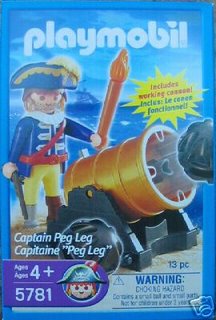
But the real turning point for me, when I began to really accept his love of pirates, was when we were shopping for more Playmobil pirates, and I came across Captain Peg Leg. With my newfound “disability rights” feelings, I didn’t like that name at all. I started to think more about how I didn’t like the eye patch or hook things, either. Why do pirates have to have these impairments all the time?

But Jordan saw Captain Peg Leg and shouted, “He has braces!” Jordan has never known a time in his life when he did not have casts or braces of some kind on his legs. So, for him, seeing someone else who had braces, which he rarely sees, was something great and new for him. I put Captain Peg Leg in the cart.


Then, while watching the pirate movies, seeing these pirates that do have hooks, peg legs (or prosthetic is the right word!), and eye patches, I started to view them differently. Yes, they have impairments, but not disabilities. The pirate with the leg prosthetic sword fights right along with the others. The one with the hook for a hand drinks his booze with the other hand. There is never any talk among the pirates about their impairments; they are seen as just another part of life. Besides, there is no time for pity or for thinking too much about any limitations—there are songs to sing, booty to steal, and adventures to have!